
What Exactly Is Climate Feedback Loops? Explained Simply — A Complete Beginner’s Guide
Climate science can feel complicated, especially with phrases like “climate feedback loops,” “positive and negative feedback,” and “tipping points” thrown around. However, when broken down into simple language and real‑world examples, these ideas become easier to understand — and even fascinating.
In this article, we’ll explore What Exactly Is Climate Feedback Loops? Explained Simply so that anyone — whether you’re a student, teacher, or just curious — can grasp how these loops work and why they matter for our planet’s future.
By the end, you’ll understand:
-
What a feedback loop is
-
The difference between positive and negative climate feedback loops
-
Common examples in the real world
-
Why feedback loops can drive climate change faster or slow it down
-
What tipping points are and why they matter
-
How scientists study and model these processes
We’ll also include step‑by‑step explanations, real anecdotes, and helpful links to reliable sources so you can dig deeper if you want.
What Are Climate Feedback Loops? Basic Definition
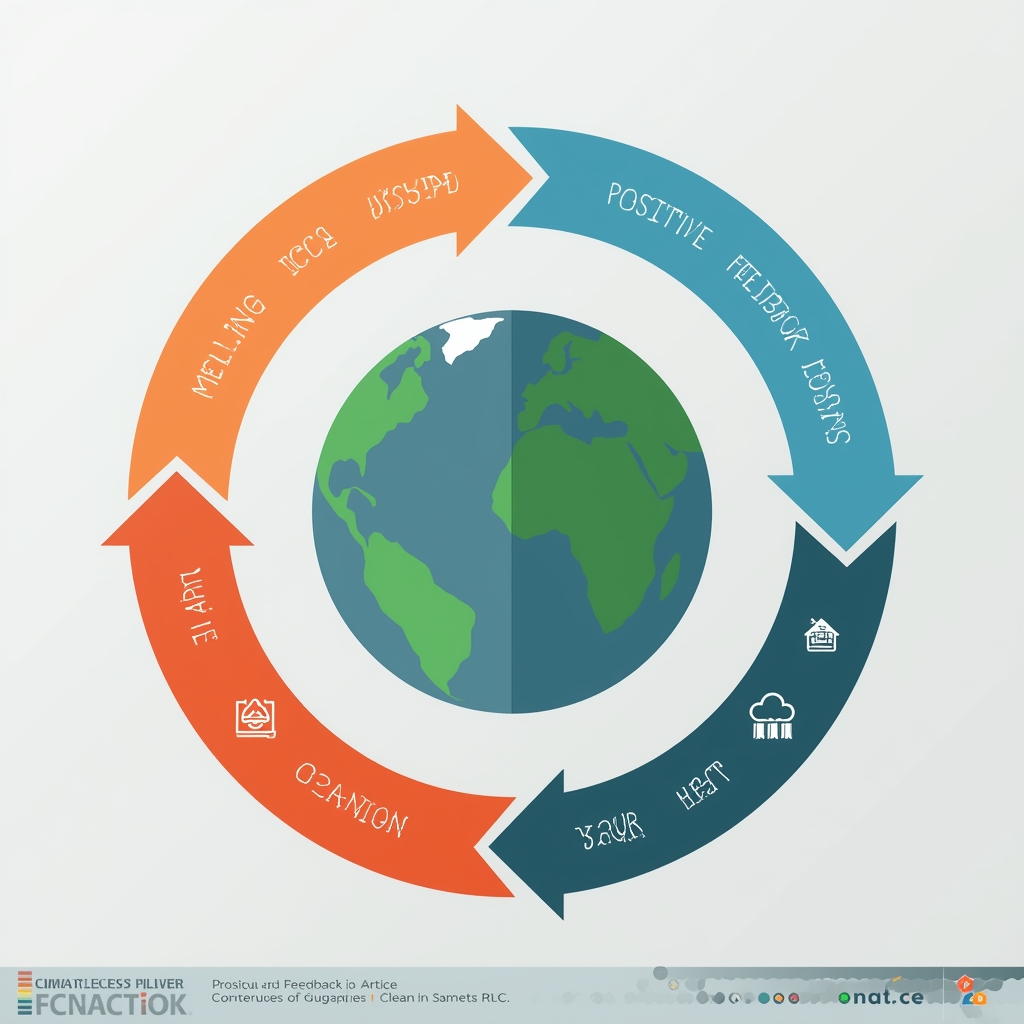
At its core, a feedback loop is a chain reaction: one change leads to another, which then affects the first thing again.
In the Earth’s climate, feedback loops are processes that either amplify (make stronger) or diminish (make weaker) the original change. In other words, once something starts happening, feedback loops can either speed it up or slow it down.
-
Positive feedback loops accelerate change
-
Negative feedback loops slow down or stabilize change
To understand this concept better, let’s compare it to something familiar.
An Everyday Analogy: The Thermostat in Your House
Imagine your house has a thermostat.
-
When the room gets too hot, the thermostat turns on air conditioning, cooling the room — this is like a negative feedback loop because it regulates and stabilizes temperature.
-
But picture a situation where you opened a window on a cold winter day while the heater runs full blast — the heater will work harder and hotter, trying to warm the room again. This would be more like a positive feedback loop, except in nature we don’t have automatic regulation if the system gets overwhelmed.
In climate terms, feedback loops can act like your thermostat — helping stabilize Earth’s temperature — or like that heater working harder and harder, making the system warmer.
Why Feedback Loops Matter in Climate Change
Climate feedback loops are critical because they influence how fast and how much the climate changes. They are part of why scientists are concerned about global warming — because some feedbacks can accelerate change beyond what humans alone caused.
Understanding these loops helps scientists:
-
Predict future climate conditions more accurately
-
Improve global climate models
-
Identify potential points of rapid environmental change
-
Develop better strategies for climate mitigation
For example, feedback loops are central to projections by the Intergovernmental Panel on Climate Change (IPCC) and other major scientific bodies.
— Source: https://www.ipcc.ch
Positive Climate Feedback Loops — Chain Reactions That Amplify Change
Let’s start with feedback loops that accelerate warming.
1. Ice‑Albedo Feedback Loop
One of the most well‑known feedbacks is the ice–albedo feedback.
-
Ice and snow are highly reflective — they bounce a large portion of sunlight back into space.
-
When temperatures rise, ice melts, exposing darker surfaces like water or land.
-
Darker surfaces absorb more heat, causing more warming and more ice melt.
This is a positive feedback loop — once it starts, it feeds back into itself and speeds up warming.
A clear explanation with visual schematics is available from the UK Met Office.
— Source: https://www.metoffice.gov.uk
2. Water Vapor Feedback Loop
Another strong positive feedback comes from water vapor.
-
A warmer atmosphere can hold more water vapor.
-
Water vapor is itself a powerful greenhouse gas, trapping heat.
-
More water vapor means more heat is trapped, leading to further warming.
This creates a cycle: warmth ➝ more water vapor ➝ more warming.
For details on water vapor’s role, see this explanatory report from the National Oceanic and Atmospheric Administration (NOAA).
— Source: https://www.noaa.gov
3. Permafrost Thaw and Methane Release
Permafrost is ground that remains frozen year‑round, mostly found in Arctic regions.
-
It stores large amounts of carbon in frozen plant and animal matter.
-
As Earth warms, permafrost thaws, and stored carbon becomes released as carbon dioxide and methane — both greenhouse gases.
-
More greenhouse gases in the atmosphere cause further warming, which causes more thawing.
This positive loop is especially worrying because methane is much more potent as a greenhouse gas than carbon dioxide in the short term.
— Source: https://www.ucsusa.org
Negative Climate Feedback Loops — Processes That Slow Change
Not all feedback loops speed warming. Some help regulate or balance changes — like brakes on a moving car.
1. Increased Cloud Cover
Warmer air causes more evaporation, which can lead to more clouds.
Some clouds reflect sunlight back into space, reducing how much solar energy reaches Earth’s surface. This helps cool the planet — acting as a negative feedback loop.
However, cloud feedback is complex because not all clouds behave the same.
— Detailed science: https://climate.nasa.gov
2. Carbon Fertilization (Plant Growth)
Plants absorb carbon dioxide through photosynthesis.
Increased CO₂ may stimulate plant growth, meaning more carbon gets taken out of the atmosphere. This can reduce the greenhouse effect, acting as a negative feedback loop.
But this effect isn’t guaranteed everywhere, especially in places limited by nutrients or water.
— Source: https://www.fs.usda.gov
3. Blackbody Radiation Feedback
As Earth warms, it radiates more heat back into space through a well‑understood physical process known as blackbody radiation.
This natural heat release helps counteract some temperature increases and is part of the Earth’s energy balance.
— Learn more: https://earthobservatory.nasa.gov
Tipping Points — When Feedback Loops Push Past a Threshold
Certain feedback loops can push the climate system past a tipping point — a threshold where change becomes rapid and difficult to reverse.
For example:
-
If the Greenland ice sheet melts beyond a certain point, it could continue melting without stopping.
-
Similarly, ocean circulation patterns like the Atlantic Meridional Overturning Circulation (AMOC) could slow dramatically or shift, changing global weather patterns.
— See research from the British Antarctic Survey: https://www.bas.ac.uk
These dramatic shifts matter because:
-
They can accelerate warming suddenly
-
They can change rainfall patterns
-
They can raise sea levels faster
-
They can disrupt ecosystems
Scientists often describe tipping points as a “point of no return” because once crossed, systems may not return to their previous state.
Step‑by‑Step: How Feedback Loops Work Together
Feedback loops don’t act in isolation; they interact in complex ways.
Step 1: Initial Climate Warming
Human activities like burning fossil fuels release greenhouse gases.
This causes Earth’s temperature to rise.
Step 2: Positive Feedback Begins
As the planet warms:
-
Ice melts faster (ice‑albedo feedback)
-
More water vapor enters the atmosphere
-
Permafrost begins thawing
Each of these accelerates warming further.
Step 3: Negative Feedback Responds
Some processes try to counteract the warming:
-
Clouds reflect sunlight
-
Plants may absorb more CO₂
-
Earth emits more heat through blackbody radiation
However, the strength of negative feedbacks doesn’t always match that of positive loops — especially when warming is rapid.
Step 4: Interactions and Net Effect
Scientists use climate models to estimate the net impact of all feedbacks combined.
Some feedbacks may cancel each other out partially, others may dominate.
This is why climate systems are still being studied intensely — because multiple loops can interact in unpredictable ways.
Regional Differences in Feedback Loops
Feedback loops are not uniform around the globe.
For instance:
-
Polar regions experience stronger ice‑albedo feedback.
-
Tropical regions have more water vapor feedback.
-
Ocean systems have unique interactions between temperature, acidification, and circulation.
These regional variations matter for:
-
Local weather changes
-
Sea level rise impacts
-
Ecosystem shifts
Maps and climate impacts by region are published by the Intergovernmental Panel on Climate Change (IPCC) — see https://www.ipcc.ch
How Scientists Study Climate Feedback Loops
Climate feedback loops are complex, and scientists use multiple tools to understand them:
-
Computer climate models: These simulate Earth’s atmosphere, oceans, and land systems.
-
Satellite observations: Track ice cover, temperature, water vapor, and more.
-
Field research: Direct measurements in forests, oceans, and permafrost regions.
Cloud feedback is a particularly challenging area because cloud formation involves small‑scale physics that’s hard to model accurately.
— NASA climate insights: https://climate.nasa.gov
Human Influence on Feedback Loops
It’s important to remember that humans don’t just cause initial warming — we also affect feedback loops.
Examples:
-
Deforestation reduces carbon absorption by forests
-
Agriculture and land use change alter albedo (reflectivity)
-
Pollution affects cloud formation and atmospheric chemistry
This means human decisions — from energy policies to land protection — influence how feedback loops operate.
Why Understanding Feedback Loops Matters for Climate Action
When we understand feedback loops, we can:
-
Predict future climate conditions better
-
Design effective climate policies
-
Prioritize actions that slow dangerous feedbacks
-
Avoid crossing tipping points
For example, reducing greenhouse gas emissions slows the initial warming that triggers many positive feedbacks.
Sources for climate action guidance include:
Common Misconceptions About Climate Feedback Loops
Myth: Feedback loops always make things worse.
Reality: Some feedbacks are negative and help stabilize the system.
Myth: Feedback loops only matter far in the future.
Reality: Many are already influencing today’s climate.
Myth: Feedback loops are too complex for ordinary people to understand.
Reality: With everyday examples, their basic logic is simple.
Final Summary: What Exactly Is Climate Feedback Loops? Explained Simply
Climate feedback loops are processes in Earth’s climate system that either:
-
Amplify change (positive feedback) — speeding warming
-
Reduce or stabilize change (negative feedback)
They are essential to understanding climate change because:
-
They influence how fast the planet warms
-
They determine whether systems can reach new stable states
-
They help us identify dangerous tipping points
Finally, while climate systems are complex, the basic ideas behind feedback loops — cycles that either strengthen or weaken effects — are easy to visualize with everyday examples.
If you want to explore more deeply or see visual diagrams:
-
NASA climate feedback explanations: https://climate.nasa.gov
-
UK Met Office interactive guides: https://www.metoffice.gov.uk