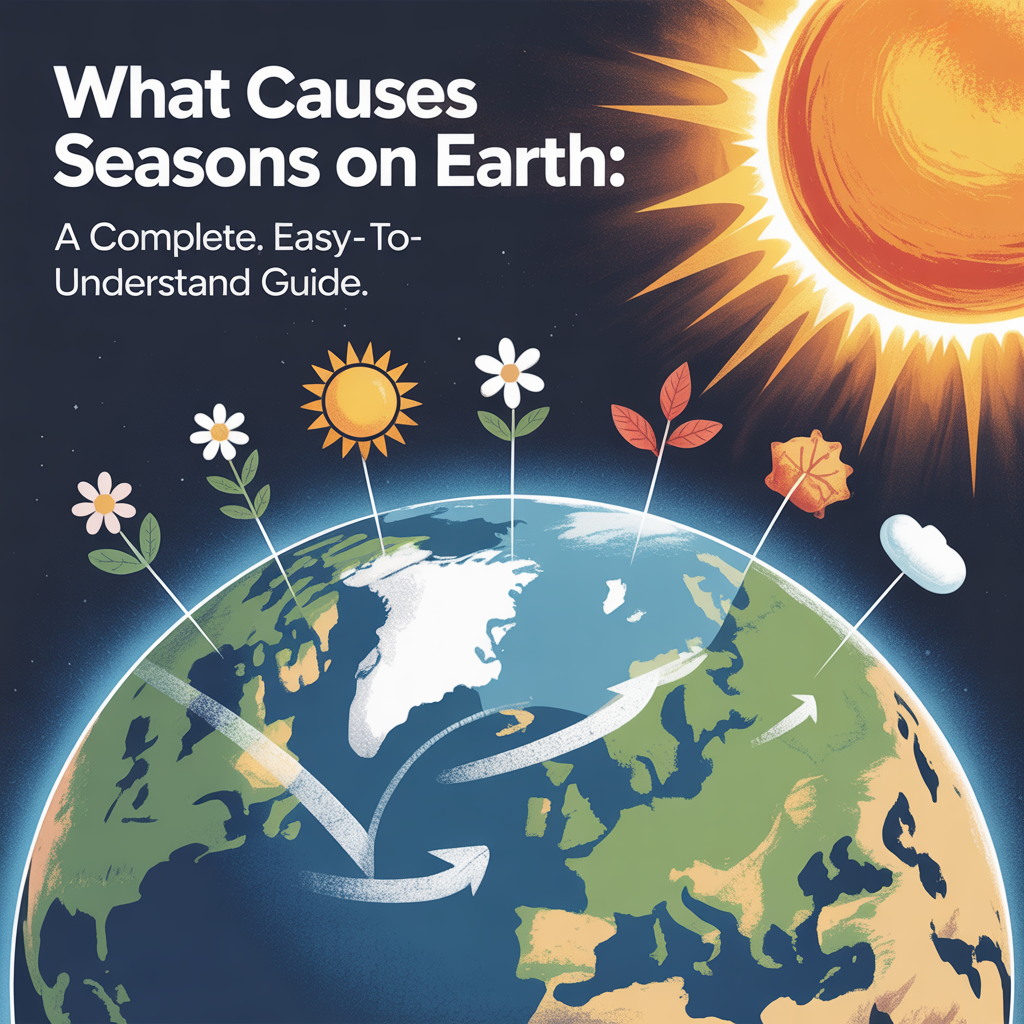

What Causes Seasons on Earth: A Complete, Easy-to-Understand Guide
If you’ve ever wondered what causes seasons on Earth, you’re not alone. Almost everyone has asked this question at some point—usually while enjoying a hot summer day or shivering through a cold winter night. At first glance, seasons may seem simple. Summer is hot, winter is cold, spring feels fresh, and autumn brings falling leaves. But why does this cycle happen year after year?
In this detailed guide, we’ll break down what causes seasons on Earth using everyday language, real-life examples, and simple step-by-step explanations. You don’t need a science background to follow along. By the end, you’ll clearly understand the science behind seasons—and you’ll also know why some common beliefs about seasons are actually wrong.
What Causes Seasons on Earth? A Simple Overview
At its core, what causes seasons on Earth comes down to one main reason:
Earth’s axis is tilted as it travels around the Sun.
This tilt changes how much sunlight different parts of Earth receive throughout the year. More sunlight means warmer temperatures; less sunlight means cooler temperatures.
However, to truly understand this, we need to look a little deeper—step by step.
Earth’s Axial Tilt: The Real Cause of Seasons
One of the most important ideas to understand what causes seasons on Earth is Earth’s axial tilt.
What Is Earth’s Axis?
Earth spins around an imaginary line called its axis. This axis runs from the North Pole to the South Pole. You can think of it like a skewer through a spinning ball.
Learn more about Earth’s axis here:
https://en.wikipedia.org/wiki/Earth%27s_axis
Why Earth’s Axis Matters
Earth’s axis is not straight up and down. Instead, it is tilted by about 23.4 degrees. This tilt is the main reason seasons exist.
Learn more about axial tilt:
https://en.wikipedia.org/wiki/Axial_tilt
Because of this tilt:
-
Sometimes the Northern Hemisphere leans toward the Sun
-
At other times, it leans away
-
The Southern Hemisphere experiences the opposite effect
This constant tilt, combined with Earth’s movement around the Sun, creates the seasons.
Earth’s Revolution Around the Sun and Seasonal Change
Another key part of what causes seasons on Earth is Earth’s revolution around the Sun.
Rotation vs. Revolution (Important Difference)
Many people confuse these two ideas:
-
Rotation: Earth spinning on its axis (causes day and night)
-
Revolution: Earth traveling around the Sun (takes about 365 days)
Learn the difference here:
https://en.wikipedia.org/wiki/Earth%27s_orbit
Important: Earth’s daily rotation does not cause seasons. Only its tilted revolution does.
Why Summer Happens: More Direct Sunlight
Let’s use a simple example.
Imagine holding a flashlight:
-
Shine it straight at a wall → bright, focused light
-
Shine it at an angle → dimmer, spread-out light
The same idea explains what causes seasons on Earth.
Summer Explained Simply
During summer:
-
A hemisphere is tilted toward the Sun
-
Sunlight hits the ground more directly
-
Days are longer
-
More solar energy reaches the surface
As a result, temperatures rise.
Learn about summer solstice:
https://www.timeanddate.com/astronomy/summer-solstice.html
Why Winter Happens: Less Direct Sunlight
Now let’s flip the situation.
Winter Explained Simply
During winter:
-
A hemisphere is tilted away from the Sun
-
Sunlight strikes at a lower angle
-
Days are shorter
-
Less solar energy reaches the surface
This is why winters are colder—even though the Sun is still shining.
Learn about winter solstice:
https://www.timeanddate.com/astronomy/winter-solstice.html
Opposite Seasons in the Northern and Southern Hemispheres
One fascinating part of what causes seasons on Earth is that seasons are opposite in each hemisphere.
-
When it’s summer in the Northern Hemisphere, it’s winter in the Southern Hemisphere
-
When it’s winter in the North, it’s summer in the South
This happens because Earth’s tilt points one hemisphere toward the Sun while pointing the other away.
Learn about hemispheres:
https://en.wikipedia.org/wiki/Hemispheres_of_Earth
What Are Solstices and Equinoxes?
To fully understand what causes seasons on Earth, we must talk about solstices and equinoxes.
Solstices Explained
Solstices happen twice a year:
-
Summer Solstice: Longest day of the year
-
Winter Solstice: Shortest day of the year
They mark the extreme tilt positions of Earth.
Learn more:
https://en.wikipedia.org/wiki/Solstice
Equinoxes Explained
Equinoxes also happen twice a year:
-
Spring (Vernal) Equinox
-
Autumn (Fall) Equinox
On these days:
-
Day and night are almost equal worldwide
-
Earth is tilted neither toward nor away from the Sun
Learn more:
https://en.wikipedia.org/wiki/Equinox
A Step-by-Step Guide: How Seasons Are Created
Let’s break what causes seasons on Earth into simple steps:
-
Earth’s axis is tilted at 23.4 degrees
-
Earth revolves around the Sun once each year
-
Different hemispheres receive different sunlight angles
-
Sunlight intensity and day length change
-
Temperatures rise or fall
-
Seasons form naturally
This cycle repeats every year like clockwork.
Common Myth: Distance from the Sun Causes Seasons
This is one of the biggest misunderstandings about what causes seasons on Earth.
Myth: Summer happens because Earth is closer to the Sun
Truth: Distance has very little effect
In fact:
-
Earth is closest to the Sun in January
-
Earth is farthest from the Sun in July
Learn about perihelion and aphelion:
https://en.wikipedia.org/wiki/Apsis
So why isn’t January the hottest month everywhere? Because tilt, not distance, controls seasons.
Why the Tropics Have Different Seasons
Another interesting part of what causes seasons on Earth is how seasons vary by location.
Tropical Regions
Near the equator:
-
Day length changes very little
-
Temperatures stay fairly constant
-
Seasons are based on wet and dry periods, not temperature
Learn about tropical seasons:
https://en.wikipedia.org/wiki/Tropical_climate
Why Polar Regions Have Extreme Seasons
At the poles:
-
Some days have 24 hours of sunlight
-
Other times have complete darkness
This creates:
-
Midnight Sun
-
Polar Night
Learn more:
https://en.wikipedia.org/wiki/Polar_day
An Everyday Anecdote: Seasons in Daily Life
Think back to school days.
In summer:
-
Schools close for long holidays
-
Days feel endless
-
Ice cream sales skyrocket
In winter:
-
Days feel shorter
-
People wear layers
-
Hot drinks feel comforting
These everyday changes are direct results of what causes seasons on Earth—even if we don’t think about the science behind them.
Meteorological vs. Astronomical Seasons
Understanding what causes seasons on Earth also means knowing how seasons are defined.
Astronomical Seasons
-
Based on solstices and equinoxes
-
Used by astronomers
Meteorological Seasons
-
Based on temperature patterns
-
Divide the year into four 3-month blocks
Learn more:
https://www.timeanddate.com/calendar/aboutseasons.html
Why Seasons Matter to Life on Earth
Seasons aren’t just about weather. They affect:
-
Plant growth
-
Animal migration
-
Human farming cycles
-
Ecosystems
Without Earth’s tilt, life would look very different.
Learn about seasons and ecosystems:
https://en.wikipedia.org/wiki/Seasonal_ecology
Final Thoughts: What Causes Seasons on Earth?
So, what causes seasons on Earth?
Earth’s axial tilt
Earth’s revolution around the Sun
Changes in sunlight angle and day length
Seasons are not caused by distance from the Sun, daily rotation, or random weather patterns. They are the result of a beautifully balanced cosmic design that has shaped life on Earth for millions of years.
Once you understand this, every sunrise, sunset, and seasonal change feels a little more meaningful.